Comparison · TriggerFlo vs Blitzit

A Blitzit alternative for when the work outgrows the list

Blitzit is the closest thing to TriggerFlo on this site: the same always-on-top timer, the same estimate-versus-actual habit. TriggerFlo puts boards, clients and invoices underneath that loop — and unlike Blitzit, it has a free tier that never expires and a license you can buy once.

Free forever up to 3 projects. Pro $45.99/yr, or $119 once. Mac, Windows, Linux, iOS, Android.

The short version

7 days

Blitzit's trial, then it asks for a card. TriggerFlo's free tier does not expire — three projects, unlimited tracking, no card.

$59.88

Blitzit for a year ($4.99/mo billed annually). TriggerFlo Pro is $45.99 — or $119 once, where Blitzit is subscription only.

Linux

Blitzit covers Windows, macOS, mobile and the browser — but never Linux. TriggerFlo ships .deb and .tar.gz for x86_64 and ARM64.

Worth saying up front: most comparison pages on this site are against time trackers built for billing, and the argument is always that they have no board. Blitzit is a different case. It has the floating timer, the per-task estimate, the overtime read, subtasks and recurring schedules — the same instincts as TriggerFlo, in a deliberately smaller package. So the question is not which app has the timer. It is whether your work stops when the focus session does, or whether it has to turn into a project, an invoice and a record you can go back to.

TriggerFlo vs Blitzit, feature by feature

A deliberately small to-do list and timer app built around one focus loop — pick a task, start the timer, watch the estimate burn down. Task lists rather than projects, with shared lists and a web app added in 3.0.

Price for one person, year one

TriggerFlo
Yes. $45.99/yr, or $119 once for lifetime
Blitzit
Partly. $59.88/yr ($4.99/mo annual), or $6.99/mo monthly

Free plan

Usable indefinitely without paying

TriggerFlo
Yes. Free forever, up to 3 projects
Blitzit
No. 7-day trial, then paid

One-time purchase option

Pay once, own it

TriggerFlo
Yes. Lifetime license, $119
Blitzit
No. Subscription only — monthly or annual

Always-on-top floating timer

TriggerFlo
Yes. Four layouts, stays above other windows
Blitzit
Yes. Yes — the centrepiece of the app

Estimate vs actual time per task

TriggerFlo
Yes. Estimate and tracked time on every card
Blitzit
Yes. Estimate, time taken and overtime per task

Kanban board with columns you define

Not just a list with states

TriggerFlo
Yes. Custom columns, drag and drop, per project
Blitzit
Partly. Lists and a fixed task flow rather than custom boards

Projects with clients and rates

TriggerFlo
Yes. Billable rates per project and per client
Blitzit
No. Lists organise tasks; no client or rate model

Invoices from tracked time

TriggerFlo
Yes. Built in on Pro, PDF and CSV
Blitzit
No. Not a billing tool

Shared projects and teammates

TriggerFlo
Partly. Roles and invitations; dedicated team plans in progress
Blitzit
Partly. Shared lists with assignees, added in 3.0

Native Linux desktop app

TriggerFlo
Yes. .deb and .tar.gz, x86_64 and ARM64
Blitzit
No. Windows and macOS only

Web app

TriggerFlo
Yes. Full web app in the browser
Blitzit
Yes. Web app added in 3.0

Smartwatch app

TriggerFlo
Yes. Apple Watch and Wear OS
Blitzit
No. Desktop and mobile apps

Music that starts with your timer

TriggerFlo
Yes. Spotify playback tied to the timer
Blitzit
No. Not a feature

Pomodoro work/break cycles

TriggerFlo
Yes. Configurable focus and break intervals
Blitzit
Yes. Built into the focus flow

AI that turns a brain dump into tasks

TriggerFlo
Yes. Flo, plus voice capture on desktop and mobile
Blitzit
Partly. Blitzy assistant, in beta

Difference 1

The same focus loop, with a project underneath it

Blitzit is built around one question: what am I doing right now? TriggerFlo asks that too — same always-on-top timer, same estimate burning down — but the task lives on a board you shaped, in a project with a client attached. When the sprint is over you still have a structure, not a cleared list.
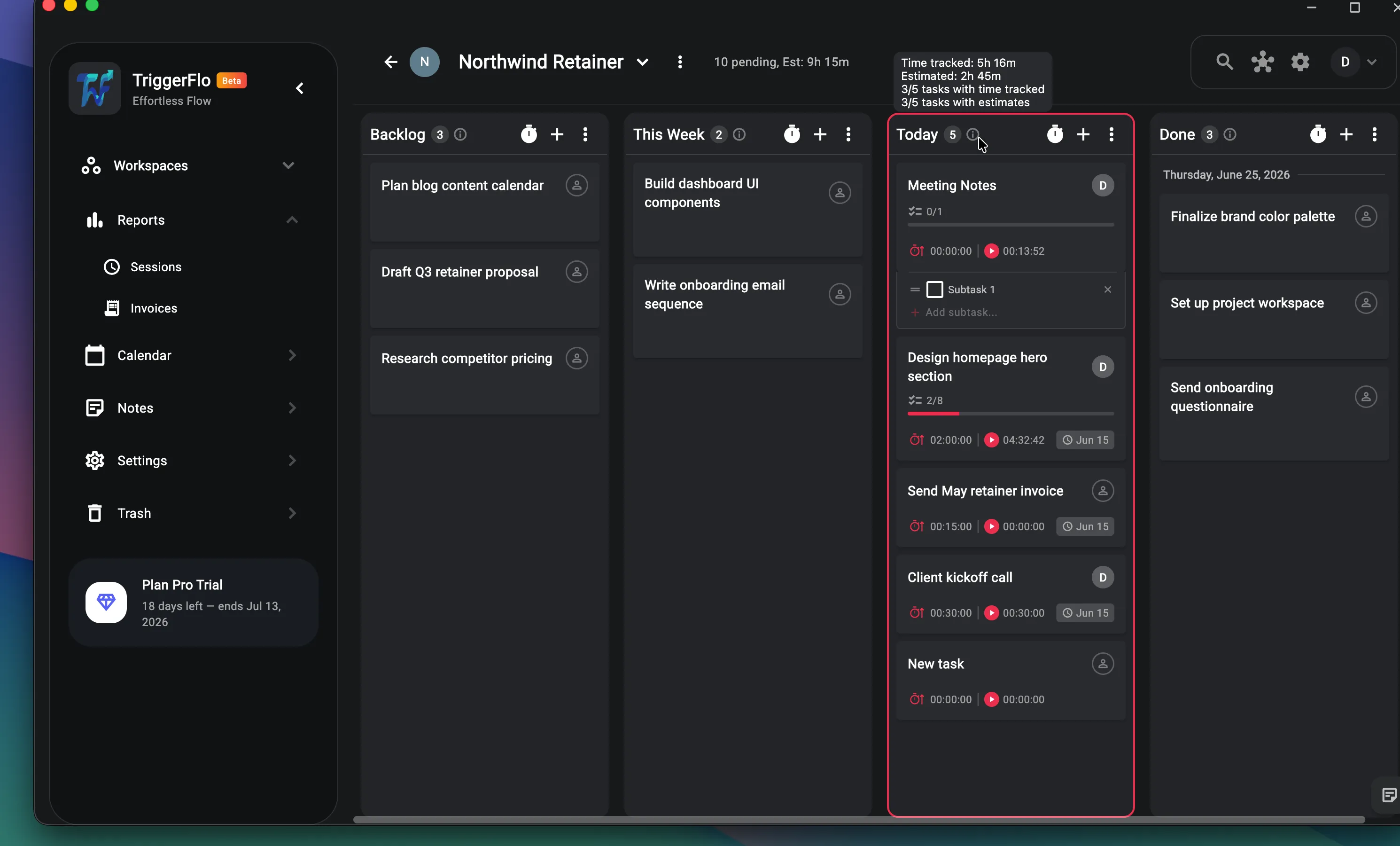
TriggerFlo project board showing cards with estimates, tracked time, subtask progress and due dates.

Difference 2

The hours you tracked become an invoice

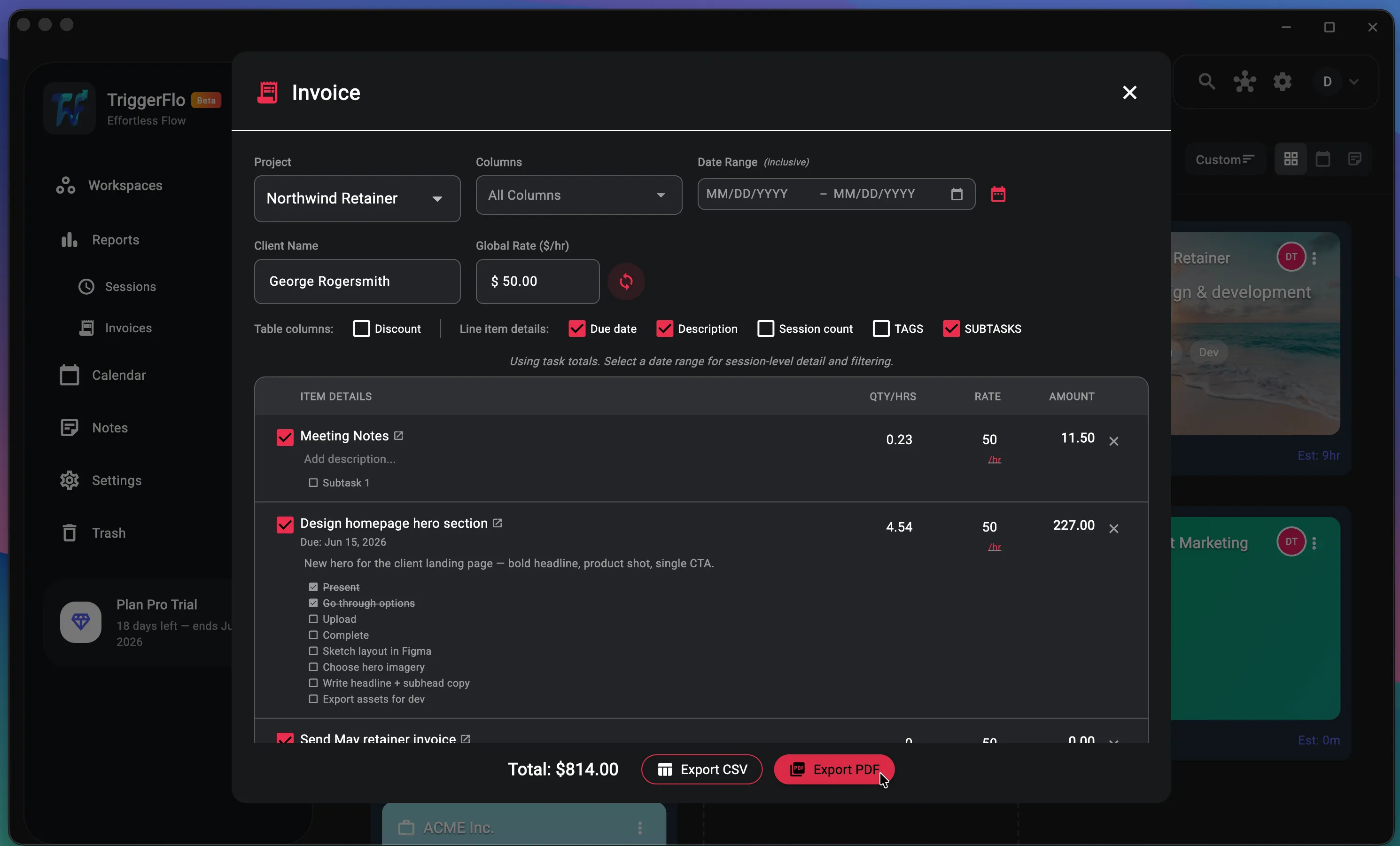
Blitzit is not a billing tool and does not claim to be — there are no clients and no rates in it, on any plan. If you bill anyone for the time you just focused through, that hand-off is a spreadsheet you maintain by hand. TriggerFlo carries the rate on the project and turns the tracked hours into a PDF invoice without you retyping anything.

A TriggerFlo invoice generated from tracked time, itemised by task with hours and rates.

Difference 3

Linux, and your wrist

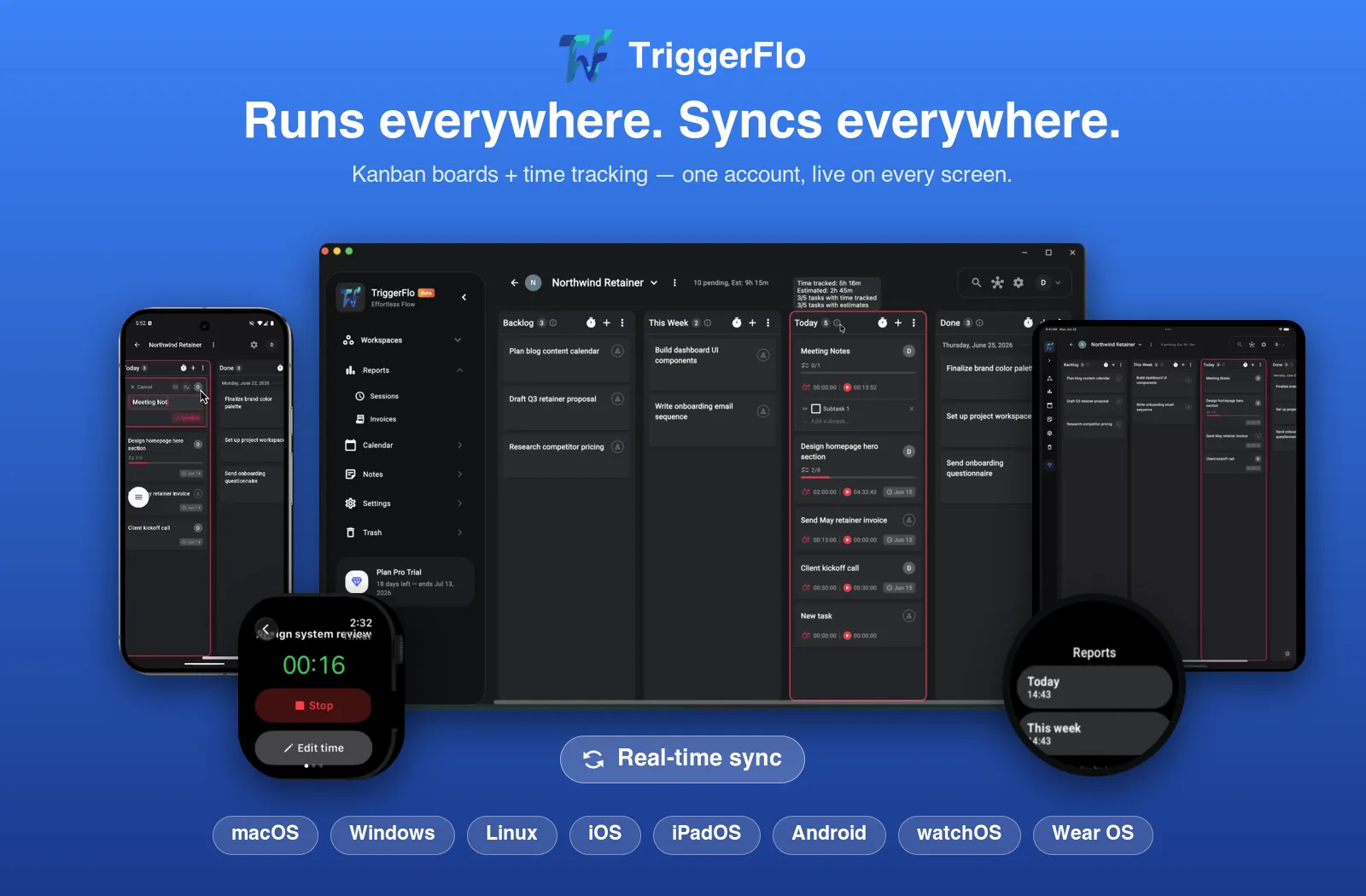
Blitzit covers Windows, macOS, iOS, Android and — since 3.0 — the browser. What it has never shipped is a native Linux desktop app or a watch app. TriggerFlo has signed .deb and .tar.gz builds for x86_64 and ARM64, Raspberry Pi included, and start/stop from an Apple Watch or Wear OS watch. If you develop on Linux, this is the whole decision.

TriggerFlo running on macOS, Windows, Linux, iOS, Android and a smartwatch.

Which one should you actually pick?

Blitzit is a good product. Here is the honest split — the cases where it is the right call, and the cases where TriggerFlo is.

Choose Blitzit if…

  • You want less software, not more

    Blitzit is small on purpose. There are no projects to set up, no columns to design, no clients, no invoices — you write the list, you start the timer, you go. TriggerFlo can be run that simply, but it does not arrive that way, and if a Kanban board is something you would never open, that is surface area you are carrying for nothing.

  • You bill nobody and track nothing long-term

    Most of what TriggerFlo adds on top of Blitzit is about what happens after the session: clients, rates, invoices, project history, roles. If your list is only ever today’s list and no one is paying you by the hour, that is weight without payoff.

Choose TriggerFlo if…

  • The work outgrows a list

    Blitzit is excellent at today. It is not built for a project that runs three months, has a client attached, and needs to be invoiced at the end of it. TriggerFlo keeps the same floating timer and focus loop, and puts a real project structure underneath — custom board columns, clients, billable rates and invoices generated from the hours you already tracked.

  • You can try it without a countdown — and buy it once

    Blitzit gives you seven days, then asks for a card, and every plan after that is a subscription. TriggerFlo’s free tier does not expire — three projects, unlimited time tracking — and if you would rather stop renting software altogether, the $119 lifetime license is a one-time payment that includes future updates. Blitzit has no equivalent.

  • Linux and your watch

    Blitzit covers Windows, macOS, mobile and — since 3.0 — the browser. What it has never shipped is a Linux desktop app or a watch app. TriggerFlo has native Linux builds for x86_64 and ARM64, Raspberry Pi included, and start/stop from an Apple Watch or Wear OS watch.

  • Sharing a list is not sharing a project

    Blitzit 3.0 added shared lists with assignees, which covers handing tasks back and forth. TriggerFlo shares the whole project — board columns, estimates, tracked hours, rates and roles — so what a teammate joins is the work and its history, not just a checklist.

TriggerFlo vs Blitzit — common questions

Is TriggerFlo just a bigger Blitzit?

Broader in scope, and that cuts both ways. Both have an always-on-top timer, per-task estimates against actual time, and a pomodoro loop. TriggerFlo adds Kanban boards, clients, billable rates, invoicing, project roles, Linux and watch apps. If what you liked about Blitzit is that it refused to do all of that, the honest answer is that you may not want the bigger app.

Can I import my Blitzit data?

Not with one click yet. Blitzit exports your lists and tasks as JSON and CSV, and that export carries the fields that matter — titles, notes, subtasks, estimates, time taken and completion state. Send the file to [email protected] and we will map it into projects and cards for you. A self-serve importer is on the list.

Which one is cheaper?

TriggerFlo, on every plan. Monthly it is $5.99 against Blitzit’s $6.99; annually $45.99 against $59.88. TriggerFlo also has a free tier that never expires, where Blitzit has a 7-day trial, and a $119 lifetime license, where Blitzit is subscription only.

Does Blitzit run on Linux?

Not natively. Blitzit covers Windows, macOS (Intel and Apple Silicon), iOS, Android and, since 3.0, a browser app — so a Linux user can reach it through the web. TriggerFlo ships actual native .deb and .tar.gz builds for x86_64 and ARM64, Raspberry Pi included, as well as a web app.

Blitzit pricing and features on this page were checked on September 19, 2026 against Blitzit home and pricing , Blitzit downloads and platforms . Plans change; check their site for today's numbers. Spotted something out of date? Tell us at [email protected] and we will fix it. TriggerFlo is not affiliated with or endorsed by Blitzit.

Bring your Blitzit export

Blitzit exports your lists and tasks as JSON and CSV — titles, notes, subtasks, estimates and time taken all come across. Send the file to [email protected] and we will map it into projects and cards for you. Free up to 3 projects, no card.

Get release notes in your inbox

New features and fixes as they ship on desktop and mobile. No spam, unsubscribe any time.